Pest birds

Common Pest Birds Around Phoenix Properties

Identify the bird, understand how it uses the building, and check nest status before selecting cleanup, deterrence, or exclusion.

  • Phoenix metro service
  • Residential and commercial
  • Humane exclusion methods
  • Solar panel solutions
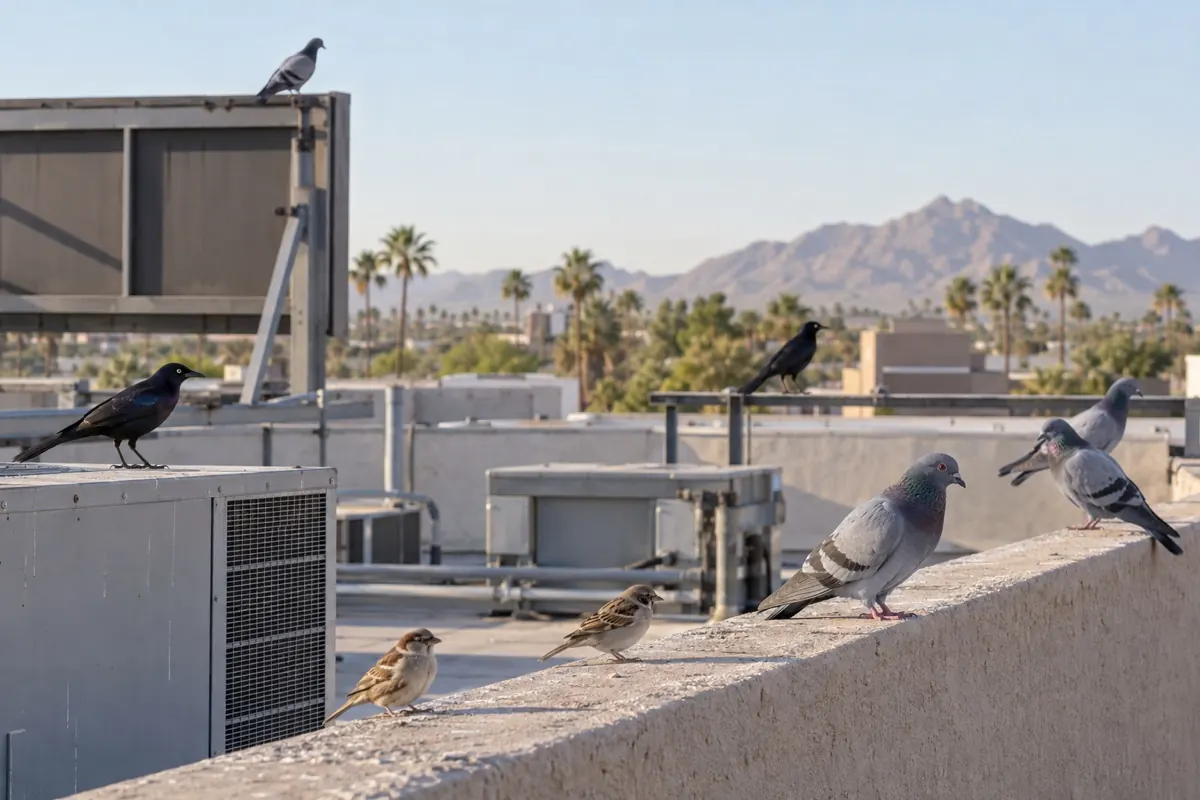
Pigeons, grackles, and sparrows using different areas of an Arizona commercial roof
Start with the problem areaSee where birds land, nest, or enter.
Use physical preventionBlock access or remove the landing space birds return to.

Identification and behavior

The species helps determine the method and timing.

Each species has different nesting and roosting habits, so correct identification matters.

Rock pigeons

Identification
Stocky gray birds with variable wing bars and an iridescent neck sheen.
Building behavior
Strong site fidelity; commonly loaf, roost, and nest on buildings.
Typical locations
Solar arrays, tile roofs, parapets, signs, bridges, and equipment platforms.
Property problem
Concentrated droppings, roof debris, cooing, and repeat nesting.
Prevention direction
Map roosts and nests, then combine cleanup with fitted exclusion or suitable landing deterrents.
Nest and legal note
Rules vary by species and situation. Confirm bird identification and active-nest status before removal or exclusion.

House sparrows

Identification
Small brown-and-gray birds; males have a black bib and gray crown.
Building behavior
Use small cavities and gaps, often close to food and busy human areas.
Typical locations
Sign cabinets, vents, eaves, canopies, rafters, and storefront openings.
Property problem
Nest material in tight spaces and scattered droppings around entries or food-service areas.
Prevention direction
Close verified entry gaps with appropriately sized screening and reduce food access.
Nest and legal note
Confirm identification before work because similar-looking native birds may be protected.

European starlings

Identification
Dark, compact birds with pointed bills and pale spotting in some seasons.
Building behavior
Travel and roost in groups and readily use structural cavities.
Typical locations
Roof voids, vents, sign cabinets, trees near buildings, and large ledges.
Property problem
Noise, cavity nesting, and concentrated group droppings.
Prevention direction
Use species-appropriate gap closure and roost management after checking occupancy.
Nest and legal note
Confirm identification before work because similar-looking native birds may be protected.

Great-tailed grackles

Identification
Large glossy black males and brown females with long keel-shaped tails.
Building behavior
Gather around parking lots, landscaped areas, water, and food sources; often roost communally.
Typical locations
Trees, parking areas, roof edges, signs, and retail landscapes.
Property problem
Noise and broad droppings below group roosts rather than one small building cavity.
Prevention direction
Reduce food and water attractants and evaluate the complete roost context; a single ledge product may not address a tree roost.
Nest and legal note
Confirm active-nest status before disturbing nests or young.

Swallows

Identification
Small, fast aerial birds with pointed wings; species and plumage vary.
Building behavior
Build mud or cavity nests and repeatedly return to suitable breeding sites.
Typical locations
Eaves, bridges, covered entries, culverts, and sheltered exterior walls.
Property problem
Mud nests and droppings below active nesting areas.
Prevention direction
Time exclusion for inactive periods and close the suitable attachment or access area before birds restart nesting.
Nest and legal note
Swallows are protected migratory birds. Do not disturb a nest with eggs or chicks; check current official guidance before work.

Crows and ravens

Identification
Large all-black birds; ravens are generally larger with heavier bills and wedge-shaped tails.
Building behavior
Use high observation points, food sources, and communal or dispersed roosts.
Typical locations
Light poles, broad roofs, trees, dumpsters, and open commercial areas.
Property problem
Noise, scattered debris, and droppings across large outdoor zones.
Prevention direction
Secure food and waste sources and evaluate the broader roost instead of assuming one building attachment will solve it.
Nest and legal note
These native birds are protected migratory species. Confirm active-nest status before disturbing a nest.
Before disturbing a nest: Confirm the species and whether eggs, chicks, or dependent young are present. U.S. Fish and Wildlife Service guidance explains that active nests may be protected and that its birds-in-buildings authorization does not cover exterior nests. Review the official bird-nest guidance, current federal authorizations, and Arizona Game and Fish guidance before work.

Next step by problem

Find the service that matches the problem.

The bird species matters, but the place it is landing, nesting, or entering usually determines the service.

Common bird problem

Pigeon Control

Pigeon control for recurring roof, patio, ledge, and solar-panel problems

View service
Common bird problem

Bird Exclusion

Bird exclusion for gaps, eaves, signs, beams, and protected nesting areas

View service
Common bird problem

Bird Netting

Bird netting for canopies, loading docks, courtyards, and other large overhead spaces

View service
Common bird problem

Bird Cleanup

Cleanup for bird droppings, nest debris, feathers, odor, and staining

View service

Not sure which bird is using the property?

Describe its size, color, flock pattern, nest location, and the building area affected. Avoid disturbing an active nest while identification is uncertain.