Birds fly into a covered volume
When the problem is inside a canopy or structure, treating individual beams may leave many alternate perches.
Phoenix metro bird control
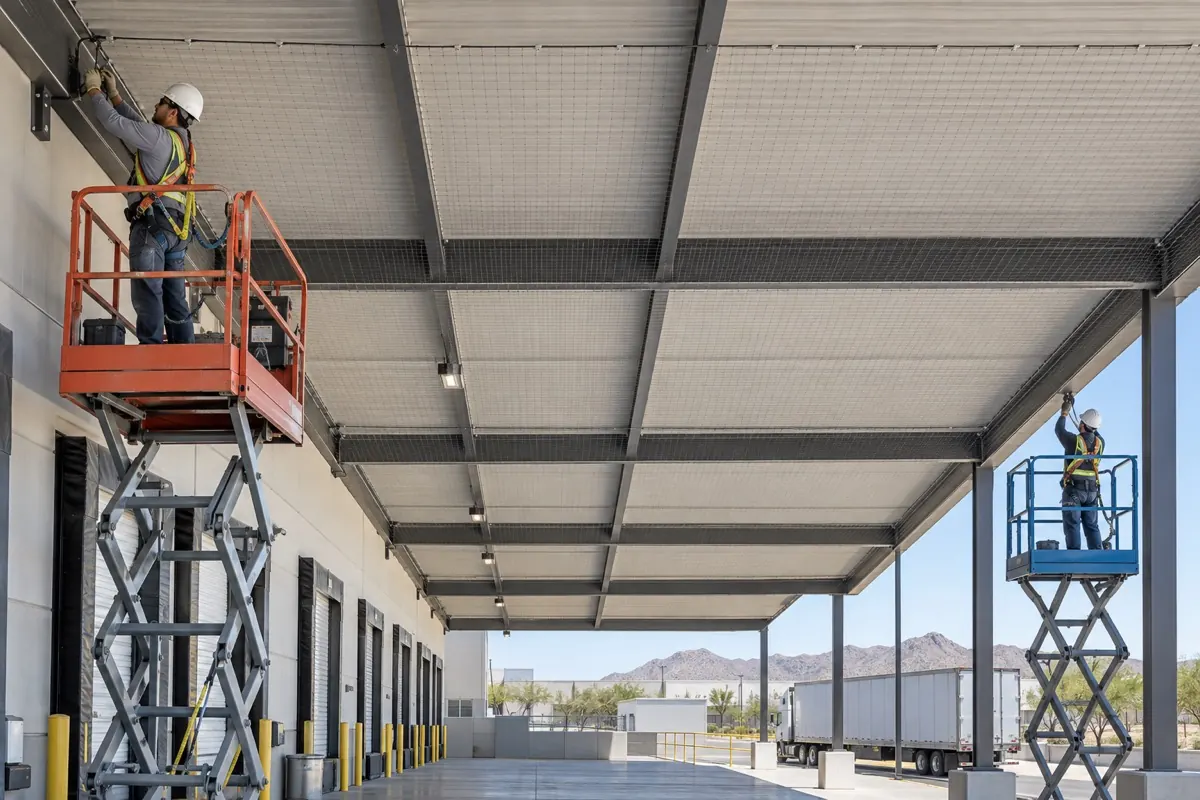
Create a tensioned barrier across canopies, courtyards, loading docks, and other large overhead spaces.
Bird Netting
Some bird problems are too large for ledge products. If birds are flying into a canopy, courtyard, loading dock, parking structure, or other open overhead space, netting creates physical separation so the area can be used without droppings and nests overhead.
What to look for
When the problem is inside a canopy or structure, treating individual beams may leave many alternate perches.
A broad pattern below multiple rafters often calls for zone exclusion rather than dozens of ledge products.
Loading docks, service bays, and covered walkways need a plan that separates birds from people and operations below.
Poor tension, open perimeter seams, or missing access details give birds a route behind the barrier.
Recommended approach
A net should create a complete exclusion plane. Cable layout, anchors, tension, seam closure, corners, and access panels all matter; loose material draped beneath a structure is not the same installation.
Define the smallest complete plane that blocks entry without enclosing unnecessary space.
Place perimeter support for even tension and suitable attachment to the structure.
Close changes in elevation, wall transitions, columns, and service penetrations.
Add planned openings where lights, equipment, fire systems, or maintenance areas need service.
Fit and limitations
Process
Map the entry routes and the smallest boundary that fully separates birds.
Locate lights, sprinklers, doors, lifts, signs, and service paths.
Install the support system, attach the net, and close the full perimeter.
Finish intentional openings with zippers, clips, or panels suited to the maintenance need.
What affects scope
Related services
Bird control for commercial buildings, warehouses, signs, loading areas, and managed properties
View serviceBird exclusion for gaps, eaves, signs, beams, and protected nesting areas
View serviceCleanup for bird droppings, nest debris, feathers, odor, and staining
View serviceService area
Bird Netting FAQs
Sagging can come from weak perimeter support, poor tension, wide unsupported spans, damaged attachments, or a layout that did not account for the structure.
They can when service access is designed into the system. Access locations should be agreed on before the net is installed.
Visibility varies with mesh size, color, light, background, and viewing distance. A tight, aligned installation is usually less visually disruptive than loose material.
A small opening, eave, or cavity is often better handled with a fitted closure. Netting is most useful when a larger three-dimensional space needs separation.
Describe the canopy, courtyard, dock, or overhead space that needs to remain bird-free.