Cooing or scratching above a room
Noise near sunrise or dusk often comes from birds moving beneath panels rather than sitting on top of them.
Phoenix metro bird control
Close the protected cavity beneath rooftop panels while preserving drainage, airflow, roof surfaces, and future service access.
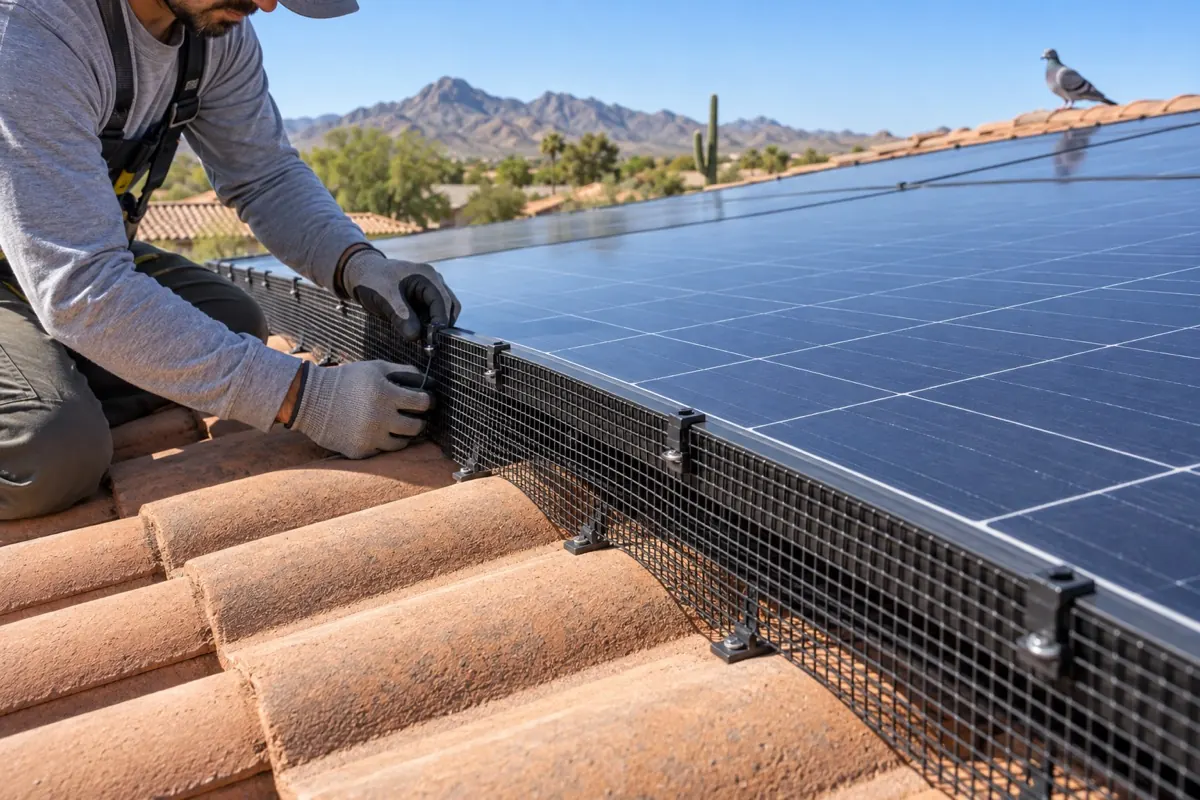
Solar Panel Pigeon Proofing
Pigeons under solar panels are noisy, messy, and frustrating because the panels give them a protected nesting pocket. Twigs, droppings, feathers, and roof debris can keep showing up after every wind or rain. We close the perimeter under the array with a roof-conscious exclusion approach so birds cannot keep nesting beneath the panels.
What to look for
Noise near sunrise or dusk often comes from birds moving beneath panels rather than sitting on top of them.
Nest material can wash or blow from the panel edge even when the nesting pocket is hard to see from the ground.
A concentrated edge can reveal the panel opening pigeons use most often.
Repeated entry at corners or uneven roof sections shows where the perimeter needs careful fitting.
Recommended approach
Solar mesh should form a continuous barrier between the module frame and roof profile. It needs to follow tile contours, hold its shape, and avoid creating new drainage or service problems.
Measure exposed edges, panel height, corners, conduit, and tile changes before cutting material.
Use an attachment approach intended for the panel frame rather than casually drilling into roof tile or roofing.
Close corners, valleys, conduit crossings, and uneven tile sections that leave easy re-entry points.
Account for the solar company's future need to inspect, lift, or replace modules.
Fit and limitations
Process
Check panel clearance, roof condition visible from the work area, bird entry points, and debris.
Determine what accessible material should be removed and whether nest activity changes the sequence.
Shape and secure the barrier around edges, corners, tile changes, and penetrations.
Review roof flow paths and note how the array can be accessed for future service.
What affects scope
Related services
Pigeon control for recurring roof, patio, ledge, and solar-panel problems
View serviceCleanup for bird droppings, nest debris, feathers, odor, and staining
View serviceBird exclusion for gaps, eaves, signs, beams, and protected nesting areas
View serviceService area
Solar Panel Pigeon Proofing FAQs
The attachment method should be selected for the module frame and installed without casually drilling into panels or roof tile. Exact compatibility should be confirmed for the array.
A common approach secures the barrier at the panel frame so the roof surface is not used as the primary attachment point. The actual detail depends on the array and roof.
Service access should be planned before installation. Sections may need to be removable or the solar provider may need to coordinate access for future module work.
Accessible debris is generally evaluated before closing the perimeter. Active nest status must be checked because it can affect what work is appropriate and when.
They can test nearby ridges, equipment, or ledges. A good inspection looks beyond the array for obvious displacement points.
Tell us about the array, roof type, visible debris, and the panel edges birds are using.